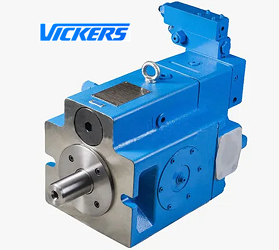
Identifying
Vickers hydraulic pumps accurately is crucial for maintenance, replacement, and system matching. The identification process mainly relies on nameplate information, model code interpretation, appearance and structural characteristics, and series-specific features. This guide details the key identification methods, covering mainstream series such as axial piston pumps and vane pumps, to help quickly and correctly recognize
Vickers hydraulic pumps.
1. Nameplate Identification (Core Method)
The nameplate is the most direct and reliable identification carrier, usually attached to the pump body (flange, shell or end cover). It contains key information that can directly confirm the pump model, specifications and basic parameters. The key information to focus on is as follows:
-
Model Number: The core identifier, which directly reflects the pump series, displacement, control mode and special configuration (e.g., PVB10, PFB20, VMQ125(T), 20V). It is the primary basis for distinguishing different types of Vickers pumps.
-
Serial Number: A unique code assigned by the factory, used to trace the production batch, manufacturing date and quality inspection information. It is helpful for verifying the authenticity of the pump and applying for after-sales service.
-
Basic Parameters: Including displacement (cm³/r), rated pressure (bar/psi), rated speed (r/min), and input power (kW/hp). These parameters are consistent with the specifications of the corresponding series and can be used to cross-verify the pump type.
-
Manufacturer Information: Marked with "Vickers" (or its parent company logo), which is the primary basis for distinguishing genuine Vickers pumps from counterfeit products. Some nameplates also include the manufacturing location.
Note: If the nameplate is worn, blurred or missing, other identification methods need to be combined to confirm the pump type.
2. Model Code Interpretation
Vickers hydraulic pump model codes follow a unified naming rule, which is composed of letters and numbers. Each part of the code corresponds to specific product information, and accurate interpretation can quickly determine the pump series and key parameters. The following are the interpretation rules for mainstream series models:
2.1 Axial Piston Pump Model Interpretation
-
PVB Series (Variable Displacement): The model is composed of "PVB + Digital", where "PVB" is the series identifier (variable displacement axial piston pump), and the following digital represents the maximum displacement level (e.g., PVB5, PVB10, PVB45). The digital corresponds to the approximate displacement value (cm³/r), which can be cross-checked with the displacement parameters in the specification table.
-
PFB Series (Fixed Displacement): The model is composed of "PFB + Digital", where "PFB" is the series identifier (fixed displacement straight-axis axial piston pump), and the following digital represents the displacement level (e.g., PFB5, PFB20, PFB45). The digital is consistent with the displacement specification of the series.
2.2 Vane Pump Model Interpretation
-
VMQ Series (Fixed Displacement): The model is composed of "VMQ + Digital + (T)", where "VMQ" is the series identifier (high-pressure fixed displacement vane pump), the digital represents the frame size (e.g., 125, 135, 145), and "(T)" indicates the through-shaft drive configuration (without "T" for single pump). The frame size corresponds to the displacement range of the pump.
-
V Series (Fixed Displacement): The model is composed of "Digital + V + (T)", where "V" is the series identifier (medium-pressure fixed displacement vane pump), the leading digital represents the frame size (e.g., 20, 25, 35, 45), and "(T)" indicates the through-shaft configuration. The frame size determines the displacement range of the pump, and the V series adopts a parent-child cartridge design.
-
V3 Series (Variable Displacement): The model is composed of "V3 + Nominal Size", where "V3" is the series identifier (variable displacement vane pump), and the nominal size (12, 25, 40, 63) corresponds to the fixed displacement of the pump (cm³/rev).
2.3 Special Marking Interpretation
Some models have additional letters or combinations to indicate special configurations or performance characteristics:
-
Letter "A": May indicate high-pressure resistance, corrosion resistance or special structural design.
-
Letter "R": Usually indicates left-hand rotation direction (default is right-hand rotation if not marked).
-
Combination "SE1S": May indicate pressure compensator control or other special functional configurations.
-
Double-digit combination (e.g., 2520): May represent a double pump model, where the two digits respectively represent the displacement levels of the two single pumps.
3. Appearance and Structural Identification
Different series of Vickers hydraulic pumps have obvious differences in appearance, structure and installation method, which can be used for rapid preliminary identification, especially when the nameplate is missing or unclear.
3.1 Axial Piston Pumps
-
PVB Series: The overall structure is compact, with a cylindrical pump body. The control device (pressure compensator, lever, hand wheel, etc.) is usually installed on the top or side of the pump body, and the oil port adopts SAE straight thread or 4-bolt flange design. The pump body is usually made of cast iron, with a matte surface.
-
PFB Series: It adopts a straight-axis design, which is lighter in weight than the PVB series. It has two installation methods: flange mounting and foot mounting. The pump body is small in size, and the oil port is arranged on the side, which is easy to distinguish from the PVB series.
3.2 Vane Pumps
-
VMQ Series: It adopts a 12-vane cartridge design, with a relatively large pump body and a smooth surface. The oil port is arranged on the end face or side, and the through-shaft type (marked with "T") has a longer shaft extension, which can be connected with other hydraulic components. It is suitable for high-pressure industrial and mobile applications.
-
V Series: The pump body is small and light, with a parent-child cartridge design. The 20V, 25V and other small frame size models are compact, while the 35V, 45V large frame size models are relatively bulky. The vane design has self-compensation for wear, and the port can be rotated flexibly for easy installation. The double-acting vane pump (such as 25V, 35V) adopts a concentric rotor structure, with radial hydraulic balance.
-
V3 Series: The structure is simple, with a small and lightweight pump body. It is equipped with an automatic air release device, and the plain bearing adopts hydrodynamic lubrication. The starting and control plates are bronze-faced, which can be distinguished from other vane pump series by its simple appearance and small size.
4. Step-by-Step Identification Process
-
Check the Nameplate: First, find the nameplate on the pump body, record the model number, serial number and key parameters, and directly confirm the pump series and specifications through the model number.
-
Interpret the Model Code: According to the model number, combined with the model interpretation rules of each series, confirm the pump type (axial piston pump/vane pump), displacement, control mode and special configuration.
-
Verify with Appearance and Structure: Observe the pump body shape, installation method, control device, oil port position and other characteristics, and cross-verify with the appearance characteristics of the corresponding series to ensure the consistency of identification results.
-
Cross-Check with Specifications: Compare the identified model and parameters with the mainstream series specifications of Vickers hydraulic pumps to further confirm the accuracy of identification.
5. Common Identification Mistakes and Notes
-
Do not confuse the displacement level in the model with the actual displacement. The digital in the model is the displacement level, and the specific actual displacement needs to refer to the nameplate or specification table.
-
For counterfeit Vickers pumps, the nameplate information may be falsified. It is necessary to comprehensively judge by combining the model code rules, appearance structure and manufacturer's anti-counterfeiting marks.
-
The same series of pumps may have different configurations (such as control mode, installation method), but the core model identifier (such as PVB, VMQ, V) remains unchanged, which can be used as the key basis for identification.
-
When the nameplate is missing, the model can be inferred according to the installation size, oil port specification and structural characteristics, but it is recommended to contact the Vickers official for confirmation to avoid misidentification.
For more detailed identification guidelines and model verification methods, please refer to the official Vickers hydraulic pump manual or contact the Vickers after-sales service department.