咨询热线:

136-8688-4195
油研
当前位置:主页 > 液压知识堂

液压知识堂

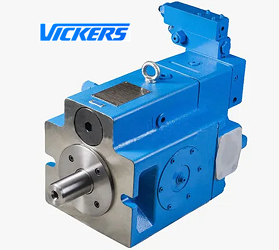
Vickers pressure compensated piston pump

更新时间:2026-04-21 14:55:54  

Vickers Pressure-Compensated Piston Pump
Vickers (now part of Eaton Corporation) pressure-compensated piston pump is an axial piston variable displacement pump, whose core feature is automatically adjusting displacement according to system pressure to achieve constant pressure and energy saving. It is widely used in medium and high-pressure hydraulic systems.

I. Core Working Principle

  1. Basic Structure: Adopting a straight-axis swashplate design, the cylinder block is driven by a motor to rotate. The plungers contact the swashplate through sliding shoes and reciprocate with the rotation of the cylinder block to complete oil suction and discharge.
  2. Pressure Compensation Mechanism:
  3. At low pressure: The compensator spring force dominates, the swashplate maintains the maximum inclination angle, and the pump outputs the maximum displacement.
  4. When the pressure rises to the set value (opening pressure): The system pressure pushes the compensator spool to compress the spring, and the swashplate inclination angle is adjusted through the stroke cylinder to reduce displacement.
  5. When the pressure drops: The spring resets, the swashplate inclination angle is restored, and the displacement rises.
  6. Finally, constant system pressure is achieved, and the flow rate dynamically matches the load, reducing energy consumption and heat generation.

II. Main Series and Models

Series
Core Features
Displacement Range
Typical Applications
PVQ Series
Straight-axis variable displacement, pressure/flow compensation, compact and lightweight
10–45 cm³/rev
Industrial machinery, machine tools, injection molding machines
PVH Series
Heavy-duty modular design, high pressure and efficiency, suitable for large flow
25–185 cm³/rev
Construction machinery, metallurgy, forging
PVXS Series
Load sensing + pressure compensation, high-precision control
50–180 cm³/rev
Precision equipment, hydraulic test benches
PVM Series
Open circuit, high rigidity, long service life
28–141 cm³/rev
Die-casting machines, machine tool spindles
Model Example: PVQ32-B2R-SE1S-21-C21D-12
  • PVQ: Series identifier; 32: Nominal displacement 32 cm³/rev; B2: Pressure compensation (2nd generation); SE1S: Control interface; 21: Pressure class; C21D: Mounting type; 12: Shaft extension specification.

III. Key Technical Advantages

  1. Energy Efficiency: On-demand oil supply reduces overflow loss, increasing efficiency by 15%–30%.
  2. Stable Pressure: Control accuracy ≤ ±1%, fast system response, suitable for precision working conditions.
  3. High Pressure Reliability: Maximum continuous pressure up to 280 bar, short-term peak pressure 310–350 bar, long service life.
  4. Strong Adaptability: Multiple control modes (pressure compensation, load sensing, remote adjustment) and customizable mounting interfaces.
  5. Compact and Lightweight: Aluminum alloy housing, small size and light weight, suitable for equipment with limited space.

IV. Typical Application Scenarios

  1. Industrial Equipment: Injection molding machines, die-casting machines, forging presses, machine tools, hydraulic test benches.
  2. Construction Machinery: Excavators, loaders, cranes, concrete pump trucks.
  3. Metallurgy and Mining: Rolling mills, mining machinery, hydraulic supports.
  4. Agricultural Machinery: Combine harvesters, tractor hydraulic systems.

V. Selection Points

  1. Pressure Matching: Confirm that the maximum system pressure matches the continuous/peak pressure of the pump (commonly 210–280 bar).
  2. Displacement Selection: Calculate according to the flow demand of the actuator and motor speed, with a 10%–20% margin reserved.
  3. Control Mode: Prioritize pressure compensation; select flow compensation for constant flow; select load sensing + pressure compensation combination for high precision.
  4. Mounting and Interface: Match the shaft extension, flange, and oil port specifications, and consider the installation space and cooling requirements.

VI. Maintenance and Precautions

  1. Cleanliness: Strictly control oil contamination (NAS ≤Class 6) to prevent wear of plunger pairs and valve plates.
  2. Oil Temperature Control: Operating temperature 30–60℃; excessive temperature will accelerate the aging of seals and components.
  3. Regular Inspection: Monitor pressure fluctuations, leakage, and noise, and promptly check the compensator spool and swashplate mechanism when abnormalities occur.
  4. Oil Selection: Use anti-wear hydraulic oil (ISO VG 32/46) to ensure lubrication and sealing performance.
With precision control, high energy efficiency, and high reliability, Vickers piston pump has become the core power source of medium and high-pressure hydraulic systems, adapting to diverse needs from precision machine tools to heavy-duty construction equipment.

相关资讯